Break the Signal, LLC + Tipsee Music LLC · Nashville
ArtistOS
A fan in a bar pays to hear a song. The artist keeps the money and gets
the fan's name. Then we hand them everything needed to do something with it.
A proposed combination of two separate companies. Not yet executed.
Confidential, for the named recipient only. Not an offer to sell or a solicitation
of an offer to buy any security.
02 The problem
A band plays to a hundred and fifty people and walks out knowing none of them.
Cash in a jar. No list, no record, no proof they were ever there.
Tomorrow they do it again, and it accumulates into nothing.
03 What it is
Two products. One artist record. Two companies putting them together.
TipSee
The front door. A QR code on the table. Fans pay to request songs, tip and send shoutouts. Live with artists in four cities. Covered by US 12,511,587 B2, granted 30 December 2025, owned by Tipsee Music LLC.
The Front Office
Everything after. The artist's site, fan database, campaigns, merch, ticketing, markets, advancing, releases, press and money. Two hundred admin screens behind ten doors. Built by Break the Signal.
TipSee gets the fan's name. The Front Office turns that name into a career.
Neither company can build the other's half.
ArtistOS is the proposed name for a combination of two separate companies.
No ArtistOS entity exists today. The combination is agreed in principle and has not
been executed. Break the Signal holds no licence to the patent above. This round is
conditional on that closing.
04 How it works
Five steps, one night, and it starts over tomorrow.
1A fan scans a code on the tableNo app, no signup. The artist's live setlist opens in the browser.
2They pay to hear a songThe artist sets the price. Free Bird costs more than a deep cut.
3The artist plays it and marks it playedPayment settles to the artist's own connected account. We are not in the flow of funds.
4The fan's name lands in the artist's databaseThe fan opts in at checkout, attached to the venue, the song and the night.
5Six weeks later the artist can email that fan about a ticketWhich is the entire point of step four.
Today TipSee owns steps one to three and the Front Office owns steps four
and five. They share no table, no route and no identifier. Joining them into one fan
record is the first thing this round builds.
05 The product · capture
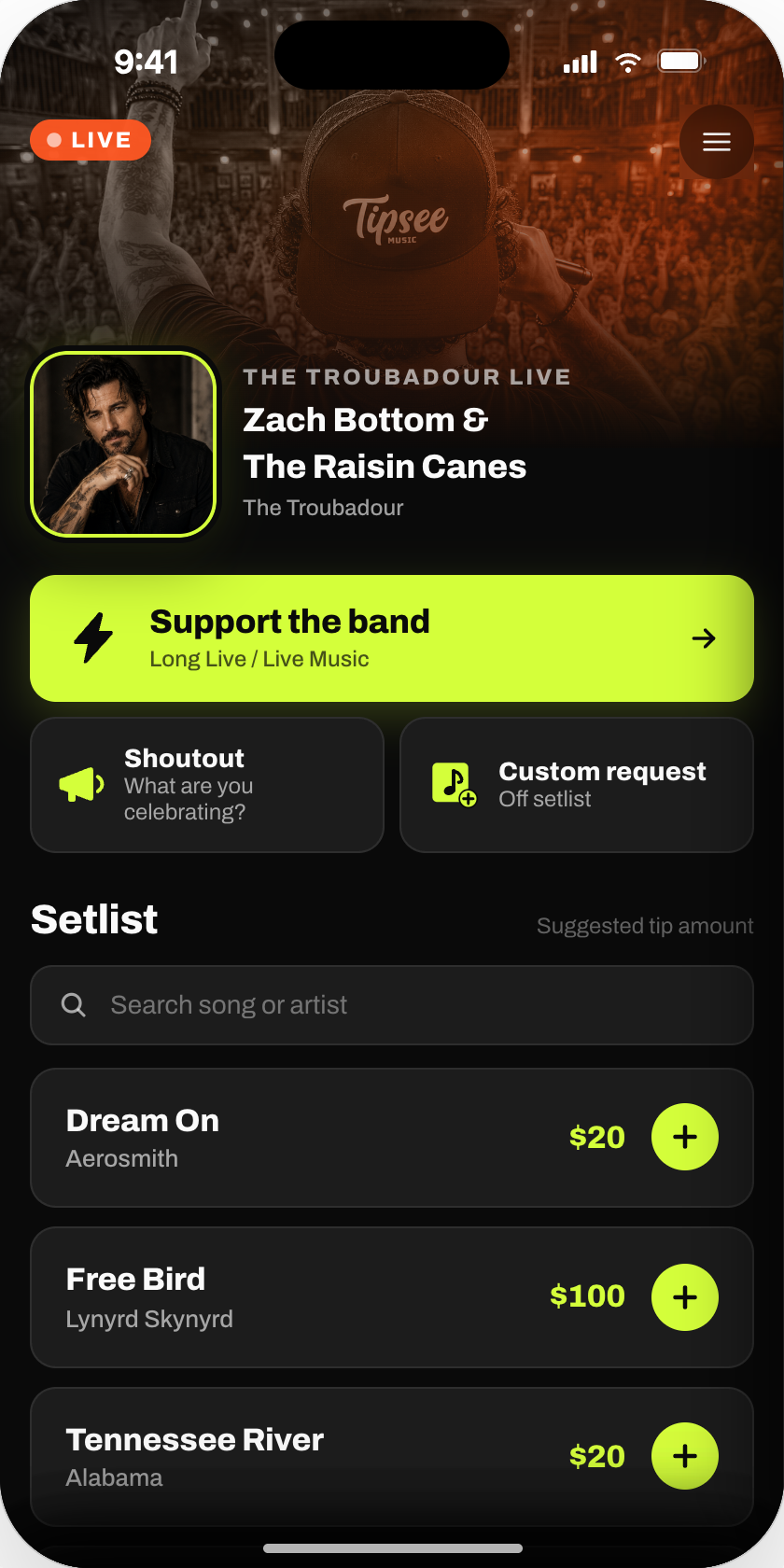
Free Bird costs a hundred dollars.
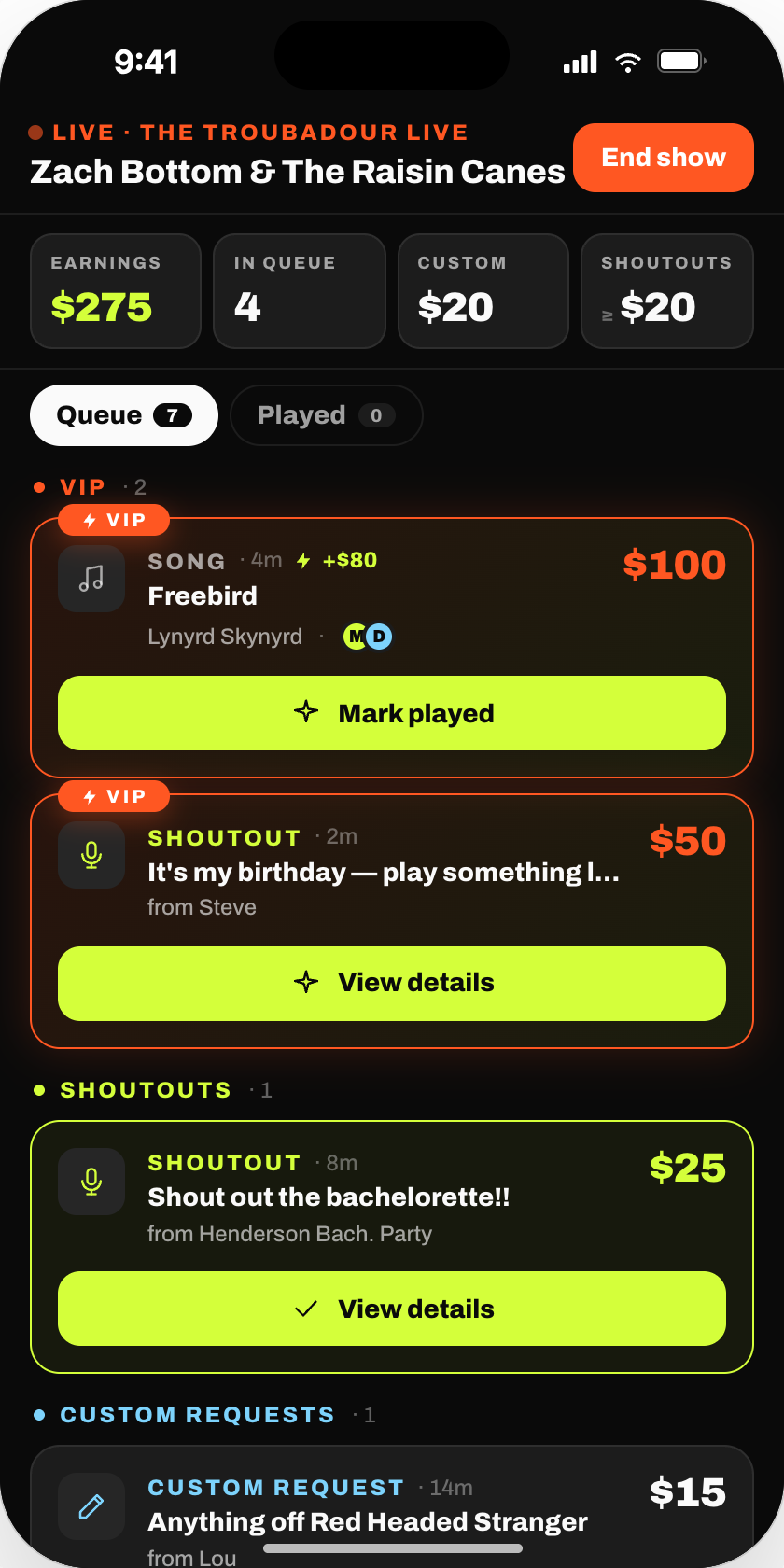
The fan · no app, no signup Tipsee Music LLC design mockupThe artist · on stage, mid-set Tipsee Music LLC design mockup
The artist sets the price per song, marks it played, and payment settles to
their own account. A good Tuesday clears a couple of hundred dollars in requests
— and every one of those payments arrives attached to a name.
The screens above are design mockups, and the figures in them are illustrative.
We will not publish a per-night average until we have twenty-five rooms of them.
06 The product · the career
Everything a career runs on, in one place they own.
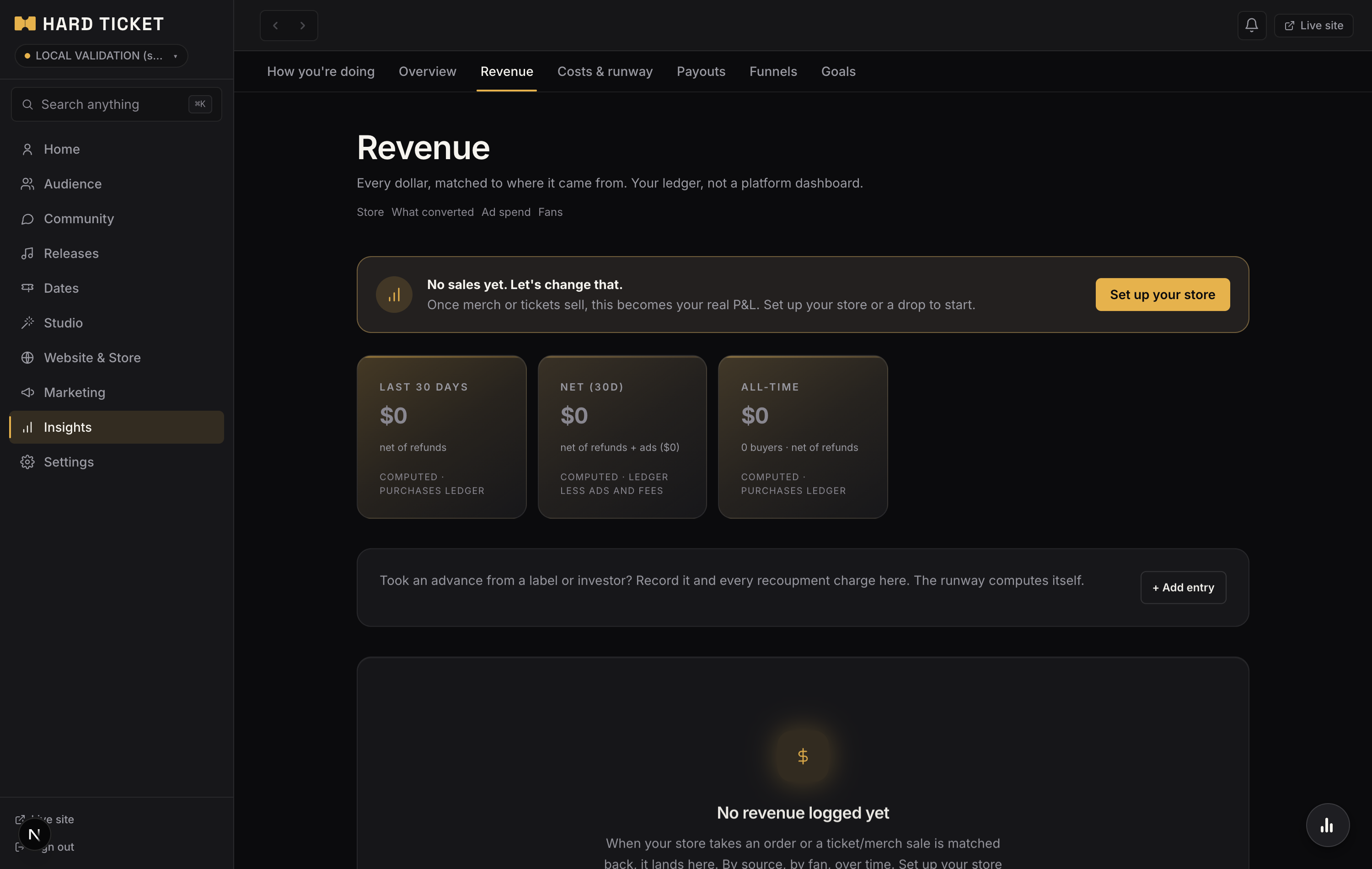
The ledger — ours, today, with nothing in it Pre-launch build. No live accounts. The zeros are real.
Their website, the fan list, campaigns drafted for approval, merch, ticketing,
markets and routing, advance sheets, releases, press and the money. The manager, tour
manager, business manager and band all work in the same system — twelve roles,
enforced on the server, tested. An AI front office drafts the work: Mona on management,
Cash on social, Paige publicist, Vera booking, Mick merch — finished work that files
itself into the calendar, the pitch list and the store when you approve it. One tap, and
every approval is a signed record.
That screenshot is our own product with nothing in it, because nobody has bought
anything yet. We publish a live scorecard of exactly what is and is not built at
hardticket.app/receipts, linked from our own homepage. It currently reads: zero real
orders, seventy-nine broadcasts written and none delivered, no booking pipeline.
07 The ladder
The artist never has to leave.
Tonight
Bar. A fan pays to hear a song.
Next
First ticketed show. That list becomes the presale.
Then
Touring. Routing, advancing, merch, settlement.
Arena
Fan-powered encores, VIP, sponsorship.
Every night adds to a payment-backed record of rooms played and draw by
market. Not who says they played — whose card was charged in the room.
Two years in, leaving means abandoning the proof.
08 The company
Three layers the music business does not have.
The data
A payment-backed record of what happens in a room. Who played, where, to whom, and who paid. The industry runs this on self-reporting and estimates.
The tools
An AI front office. The week's posts, the press pitch, the release plan — drafted work approved in one tap, not advice.
The money
Sponsorship nobody could sell before. Hundreds of small rooms aggregated into one verified, addressable, redeemable media buy.
Capture the moment, tool the career, sell the audience.
Each layer makes the next possible. Slide 14 is everyone who owns one of them,
and nobody who owns the chain.
09 The customer
$21,300
Median annual music income for a US musician, in 2018 dollars.
Sixty-one per cent say it does not cover living expenses. The companies that tried
to charge this customer mostly did not survive it. The ones that did are small, and priced
under twenty-five dollars a month.
Music Industry Research Association with the Princeton University Survey Research
Center, 2018, n=1,227. Still the citation of record: the BLS publishes an hourly wage for
this occupation and no annual figure, and excludes the self-employed, who are half of it.
10 The model
The artist never pays to be captured.
Capture — free
Tips and requests. The tip jar is free to the artist everywhere it exists, so it is free here. It is the instrument, not the revenue.
Front office
$29 to $149 a month, published today. Priced against the hire, not the software.
Roster
Management companies. One contract, hundreds of artists.
Venue
Which act actually drives bar spend. Nobody has ever known.
Sponsorship
Verified, addressable, aggregated. The margin line.
The artist buys an office because it replaces one they cannot afford to staff.
They never pay for the thing that is free everywhere else.
11 The unit
One room, one month — and two cells nobody has ever filled.
Merch GMV$12.2–16.2k
Our take, 5%$610–810
Venue seat$150–400
Tipsno data
Sponsorshipno data
Per 150-cap room per month: 20 artist-nights, ~90 attending, 1,800 attendee-nights.
Merch GMV is gross consumer spend in the room, not our revenue. Our revenue is the take.
Derived from atVenu's $45 per buyer at small shows × 15–20% conversion = $6.75–9.00 per head.
Note what atVenu's headline actually says: its $64 is spend per buyer, not
per head — only 23% of fans buy anything. Read literally it overstates merch
four-fold, and the all-time record merch night was $44.48 a head. Nobody publishes tips
per show or local sponsorship rates at this tier. That is precisely what the twenty-five
rooms are for.
12 The unit economics
The room pays back. One artist at twenty dollars does not — so it is not twenty dollars.
A venue
$14,060 to land, $894 a month of contribution, paid back in 15.7 months, 3.2x over its life. An annual term and a record of which act actually filled the room is a switching cost no pure-SaaS competitor carries.
An artist at $20
$574 to land against $406 of lifetime value. 0.71x. It never pays back — 33 months of payback against a 23-month customer life at benchmark churn.
So the roster is $79
Same customer, same acquisition cost, 3.1x and paid back in 7.5 months. Priced off the payback, not off what the tip jars charge.
We built this model before we raised and it killed our own price. The venue is the
unit that works. The artist only works if you charge like an office instead of an app.
Internal model, unaudited, run at low, base and high. Churn of 4.29% a month is the
Recurly benchmark for the $10–25 band, not ours — we have none of our own yet.
13 Where the margin is
The live business makes its money selling access, not tickets.
Concerts4.8%
Ticketing38.8%
Sponsorship67.1%
Live Nation adjusted operating income margin by segment, Q2 2026.
Non-GAAP, as reported by the company.
Concerts grew 8% in revenue and lost 14% of its profit. Sponsorship is 5.9% of
concerts revenue and 83% of its profit.
Below the superstar tier that margin barely exists, because a brand
cannot do three hundred deals with three hundred bar bands. Aggregation is the unlock.
14 Why this gets big
Nobody has ever measured the room.
"All PROs who responded to this question reported that they use proxy or
survey data for royalty distributions, to some extent. … Proxy or survey data appears to be
most often used to supplement incomplete data for performances at smaller live performance
venues and by general licensees."
United States Copyright Office, Summary of Comments, at 19. Transmitted to the
House Judiciary Committee, 20 November 2025.
15 The landscape
Everyone owns one piece. Nobody owns the chain.
Who exists
PickleJar, Tiply, Rekwest — the tip jar. The moment, no system, and all three are free to the artist. PickleJar is Nashville, and its published pricing places the fee on the fan.
Laylo — artist CRM. $8M raised, marquee artists, no round publicly disclosed since 2022. Reach, no capture.
Bandsintown — fan discovery, from $274/mo for venues, billed annually. Intent, not money.
Prism, Muzeek, Gigwell — booking workflow for people who already book.
atVenu — $2B+ processed annually, company-reported. Ops for touring acts, nothing below the club.
Who ran out of road
Sessions — a Pandora co-founder made tipping the revenue line. It shut in December 2022, and creators publicly reported unpaid balances.
Rival — $30M+ raised, founded by a former Ticketmaster CEO. It never reached a public on-sale, and the team went to Ticketmaster.
Songkick — ~$60M raised. Its antitrust claim against Live Nation settled for a reported $110M in 2018, after its ticketing business had already closed.
Jaxsta — 240M credits, hibernated December 2025: "the commercial model was not scalable in its current form."
Bkstg — roughly $20M raised for direct-to-fan. Its CEO and president both departed and the product has not shipped since.
Nobody here died of competition. They died of transaction volume that never
arrived, and of charging a customer with no money. And not one of them holds both the
capture and the career.
16 The hard questions
What you are going to ask, and what is not true yet.
What you are going to ask
"Take rates here are going to zero." They are. PickleJar is 0% to the artist, Bandzoogle 0% on sales, Grin abandoned take-rate for subscription. Which is why capture is free and the revenue sits with the office, the venue and the brand.
"Small rooms are shrinking." Sub-500-cap attendance fell 1% last year while stadiums grew 6%. The contraction is why venues will take a system that tells them which act drives bar spend.
"That is the worst churn band in SaaS." Benchmark churn at this price point is 4.29% monthly, about 41% a year. We have none of our own yet. The venue record is the switching cost no pure-SaaS competitor has.
"Nobody is funding live-music tooling." In August 2026 a live-entertainment financial-operations company raised a $5M seed led by TTV Capital, with three working operators on the cap table — an artist manager, a management-company founder and a festival founder. That is the shape of this round: one fund that understands payments, and people who have stood in the room.
"Toast gives hardware away." So do we. Hardware is about $550 a room. It is customer acquisition, not a revenue line.
"25 venues in 18 months is slow." It is 1.4 a month, deliberately, and it is two corridors rather than scattered rooms. One operator runs nine rooms on Lower Broadway — a third of the target in a single contract, and half a street a brand can buy as one placement. The second corridor is East Nashville, where the rooms are independent and the strain is public: a Five Points venue is currently selling a support pass to cover last year. Ten per cent of a city is a sample.
What is not true yet
The combination is not executed. Two separate companies, agreed in principle. This round is conditional on closing it, and on a Delaware entity that can issue the instrument.
The patent is Tipsee's. US 12,511,587 B2, inventor Dallas Jackson, assignee Tipsee Music LLC. It comes with the combination or it does not come. We have not had counsel opine on the scope of the granted claims and will not characterise them until they have.
No transactions on the Front Office. Built and unsold. One Stripe platform key and one artist's bank onboarding stand between the store and its first sale. Fan email stays locked by choice until artists are onboarded.
No booking pipeline. No holds, avails or offers. What exists is markets and routing intelligence, and we renamed it in our own product for exactly that reason.
Unproven audio. We ship artist-confirms. Audio recognition stays on the roadmap.
Slow rosters. Every artist is a veto point. Two quarters, not one month.
We would rather you heard all of this from us. The live version is at
hardticket.app/receipts, counted automatically, on our own marketing site, today.
17 Why us
Twenty years inside the machine.
The rooms
Twenty years working with Sony Nashville, Universal Nashville, Geffen and the Country Music Hall of Fame.
The artist
Eight years at Tim McGraw's management company as VP of marketing and digital. Soul2Soul: The World Tour, 2017–18, grossed $100.3M on 1.26M tickets.
The receipt
Co-founded Music City Rodeo, the first PRCA-sanctioned rodeo held in Nashville. Three nights at Bridgestone Arena in year one.
The venture
Co-founder and Chief Strategy Officer of Down Home, launched with Tim McGraw and backed by Skydance and Shareability.
The build
Tipsee: a shipped capture product in four markets. Break the Signal: two hundred screens, 206 tables, 3,163 passing tests.
18 The ask
Saturate one street. Then every street.
Raising
$2.5M on a SAFE, into a Delaware entity both companies contribute to. Offered only to accredited investors, through subscription documents.
Runway
26 months at plan, not 18. The eighteen-month milestone — 25 rooms, one joined fan record, the first measured dataset — is reached with $697K still in the bank. We are not raising to the edge of the cliff.
Venue product
$1.05M — the venue side does not exist yet, and joining the two fan records is the first build.
Field
$525K — two corridors, 25 rooms. Hardware is $14K of it; the rest is people.
Roster
$400K — management companies, not artists one at a time.
Legal & IP
$275K — including closing the combination and recording the patent assignment.
Second city
$250K — standing up at month 12, because one city proves demand and two prove a business.
What it buys: one artist tracked from bar tip to ticketed show on the same fan
record, and the first measured dataset of what a small room is actually worth.
At 250-plus venues, Nashville has roughly six times the live-venue density per capita
of New York or Tokyo. Nashville Independent Venues Study, Metro Nashville with the Nashville
Area Chamber of Commerce, 2024.
Spotify told artists what people listen to. Nobody ever told them what happened in the room.
Brian Kaplan · Break the Signal, LLC · Nashville
brian@breakthesignal.com